
Drift vs Spot-Lock Inshore: When to Drift and When to Hold
There is no one right answer every day in Rockport. The better call depends on what the water is doing, how tight the fish are grouped, and how much control you need over the boat.
A good rule is simple: drift when you need coverage, and hold when you need precision. That fits Rockport fishing inshore well, because fish often move between drains, guts, drop-offs, grass, flats, reefs, and shorelines instead of staying in one type of water all day (Texas Parks & Wildlife Rockport fishing reports).
For a mixed crowd of first-timers, weekend anglers, and serious inshore fishermen, this is the clean way to think about it: drifting helps you find the pattern, and holding helps you fish the pattern once you find it.
The quick answer
Drift when:
Fish seem spread out
You are searching a long shoreline or broad flat
Bait is scattered
Wind or tide will push you down a good lane
You want a natural look with less stopping and starting
Hold when:
You found a small sweet spot
Fish are stacked on a drain, edge, or pothole
The boat keeps sliding off the target
You need repeat casts to the same zone
You are fishing with newer anglers who need a stable setup
Why drifting works so well in Rockport
Drifting is about coverage. On many inshore days, that matters more than sitting still.
When you drift, you can work more shoreline, more grass, and more bottom change without burning a lot of time. That helps when redfish, trout, or drum are using a broad area instead of pinning to one tiny target. It also lets you watch for signs that tell you where to stop next, like bait flicking, nervous water, slicks, or a small cluster of bites.
Drifting also fits the way water moves. According to NOAA Ocean Service’s tides and currents guide, currents are driven by tides, wind, the shape of the land, and even water temperature. In plain terms, the water in front of Rockport is always doing something, and drifting often lets you fish with that movement instead of fighting it.
That is a big deal on grass flats, along long shorelines, and across pothole fields. If fish are roaming and feeding across a lane, a drift keeps your lure in front of more fish.
Pros of drifting
Covers water fast
Helps you find fish before you commit
Can look natural when the boat moves with the water
Great for broad flats, grass edges, sand pockets, and long banks
Cons of drifting
Easy to slide past the best zone
Harder to keep the same casting angle
Tougher in heavy wind
Not ideal when fish are on a tiny target
Why Spot-Lock shines when fish are pinned down
Spot-Lock is a boat-control tool, not a magic fish button. Used the right way, it keeps you in range of a small strike zone.
On the official Minn Kota Spot-Lock page, Spot-Lock is described as a GPS anchor that locks your boat onto a fishing spot and helps when wind, waves, and current try to move you off it. That is exactly why it helps inshore when fish are set up on a drain mouth, shell edge, drop, reef corner, or current seam.
This is where holding beats drifting. If three bites come from one pothole, one edge of a drain, or one little bend in a shoreline, drifting away from it makes no sense. Holding lets you make the same cast again, adjust your angle, and keep the boat where it needs to be.
Pros of Spot-Lock
Better precision on small targets
Lets you repeat the same cast
Helps in wind or current when the boat will not stay lined up
Good for drains, drops, shell, reef corners, and small bait concentrations
Cons of Spot-Lock
Covers less water
Can hold you on dead water too long
Not always the best move when fish are roaming
In very skinny water, poor setup can still put too much pressure on the fish
Stealth: which one is quieter?

A lot of anglers think drifting is always stealthier. Not always.
A clean drift is very quiet. You are not making constant position changes, and the boat is moving with the conditions. That is hard to beat on shallow flats.
But a hold can be quiet too if you stop outside the fish and stay in casting range instead of sliding right over them. The mistake is not Spot-Lock itself. The mistake is hitting it too close.
That matters in this area because Rockport sits near sensitive shallow grass. Texas Parks & Wildlife notes on its Redfish Bay seagrass protection page that seagrass grows in shallow water, is vulnerable to prop damage, and led to mandatory rules in the Redfish Bay State Scientific Area after years of scarring. In other words, shallow-water positioning is not just about catching more fish. It is also about running the bay the right way.
Let wind and tide make the call
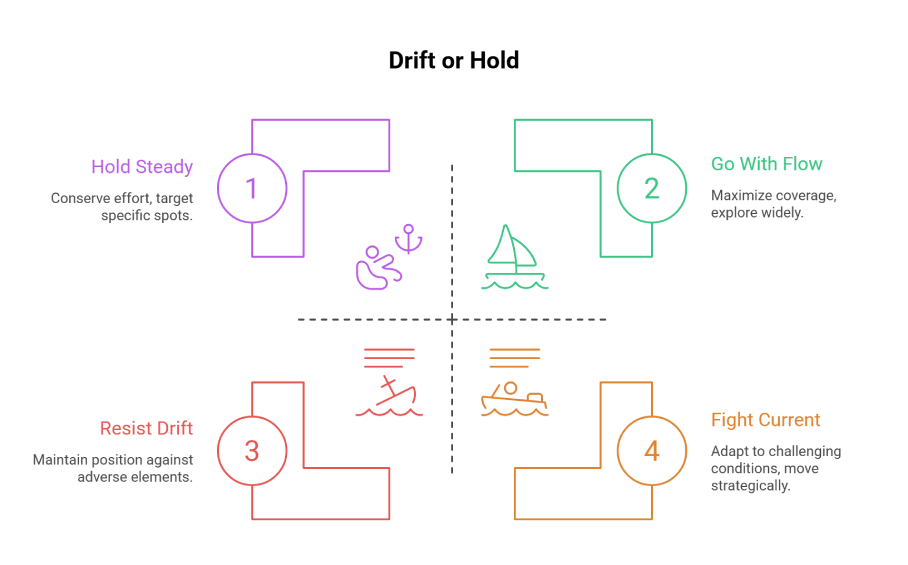
If the wind and tide are helping you, drift.
If the wind and tide keep pulling you off the target, hold.
That is the cleanest way to make the call in real time. The NWS Corpus Christi marine forecast zones cover Copano, Aransas, and Redfish Bays, plus the nearby coastal water outside Port Aransas. Checking that forecast before you leave tells you a lot about how hard the boat will want to slide, how clean a drift may be, and whether holding on a small zone will save the day.
Here is how that plays out:
When drifting makes more sense
Light to moderate wind pushing you down a shoreline
Fish are spread along a grass edge or flat
You are still trying to find where the better bites are coming from
The bottom change runs for a long distance
When holding makes more sense
Wind keeps blowing you off a drain or pothole
Current creates one small feeding lane
The fish are on one side of a shell patch or drop
You already know where the bite window is
Best structure for drifting in Rockport
Drifting is usually the better move on:
Broad grass flats
You can cover a lot of water and find active fish without guessing on one tiny spot.
Long shorelines
These are perfect when fish are moving and feeding along a lane instead of sitting in one pocket.
Sand pockets and pothole fields
One drift can show you where the better bottom change is and which holes are holding life.
Windblown banks with scattered bait
If the bait is spread out, the fish often are too.
Best structure for Spot-Lock or holding
Holding is usually the better move on:
Drains and guts
These funnel fish and bait through smaller windows.
Drop-offs and channel edges
A small depth change can hold fish in one narrow band.
Shell edges and reef corners
These spots often fish best from one clean angle.
Small bait concentrations
If all the life is packed into one small area, stay in range and work it.
A simple decision frame you can use on the water
Start by drifting unless you already know the exact target.
If you get one random bite, keep moving.
If you get two or three bites from the same small zone, hold.
If the action dies after a few repeat casts, start drifting again.
That back-and-forth is how a lot of strong inshore days come together. You use movement to find fish, then use control to stay on them.
Modern systems even split those jobs into two clear modes. On the Yamaha Helm Master EX page, DriftPoint is described as maintaining boat heading but not position during a controlled drift, while StayPoint maintains both heading and position. That lines up with the real on-the-water choice anglers make every trip: go with the flow, or lock in and work one zone.
Common mistakes with both styles
Drifting too fast
If your lure is racing the fish, you are not fishing the drift. Slow it down, use a drift sock if needed, or change the angle.
Holding too close
If you stop right on top of the fish, the best cast is already behind you.
Staying too long on dead water
Boat control is only useful if the fish are there.
Ignoring casting angle
A shell edge or drain can fish very differently from one side to the other.
Forgetting about the bottom
Grass, mud, shell, and potholes can all change the right move.



The best inshore captains use both
The smartest Rockport game plan is not drift only or hold only.
It is knowing when to switch.
That is what makes a guide trip easier for a mixed group. New anglers get a clean setup when it is time to hold, while more experienced anglers still get the fun of covering water and figuring out a pattern. We keep it simple: use the drift to find life, use the hold to fish the sweet spot, and do not force one method when the day is asking for the other.
If you want a Rockport trip that keeps things straightforward, family-friendly, and built around real conditions, not guesswork, let’s get you on some fish. Contact us today!
Frequently Asked Questions
-
Not every time. Drifting is usually better when redfish are spread across flats, grass edges, or long banks. Spot-Lock is better when they are grouped on a drain, pothole, shell edge, or another small target.
-
Use it when the flat has one high-value zone inside it, like a pothole, drain, or edge where bites are stacking up. If the whole flat looks alive and the bites are scattered, keep drifting.
-
A clean drift can be very quiet, especially in shallow water. But a well-set hold can also be quiet if you stop outside the fish and stay in casting range instead of parking on top of them.
-
They decide how much control you need. If wind and tide are helping you move down a good lane, drifting usually looks better. If they keep pulling you off the sweet spot, holding usually wins.
-
Drifting fits broad grass flats, long shorelines, pothole fields, and scattered bait. Holding fits drains, drops, channel edges, shell lines, reef corners, and any place where repeat casts to one small zone matter most.